
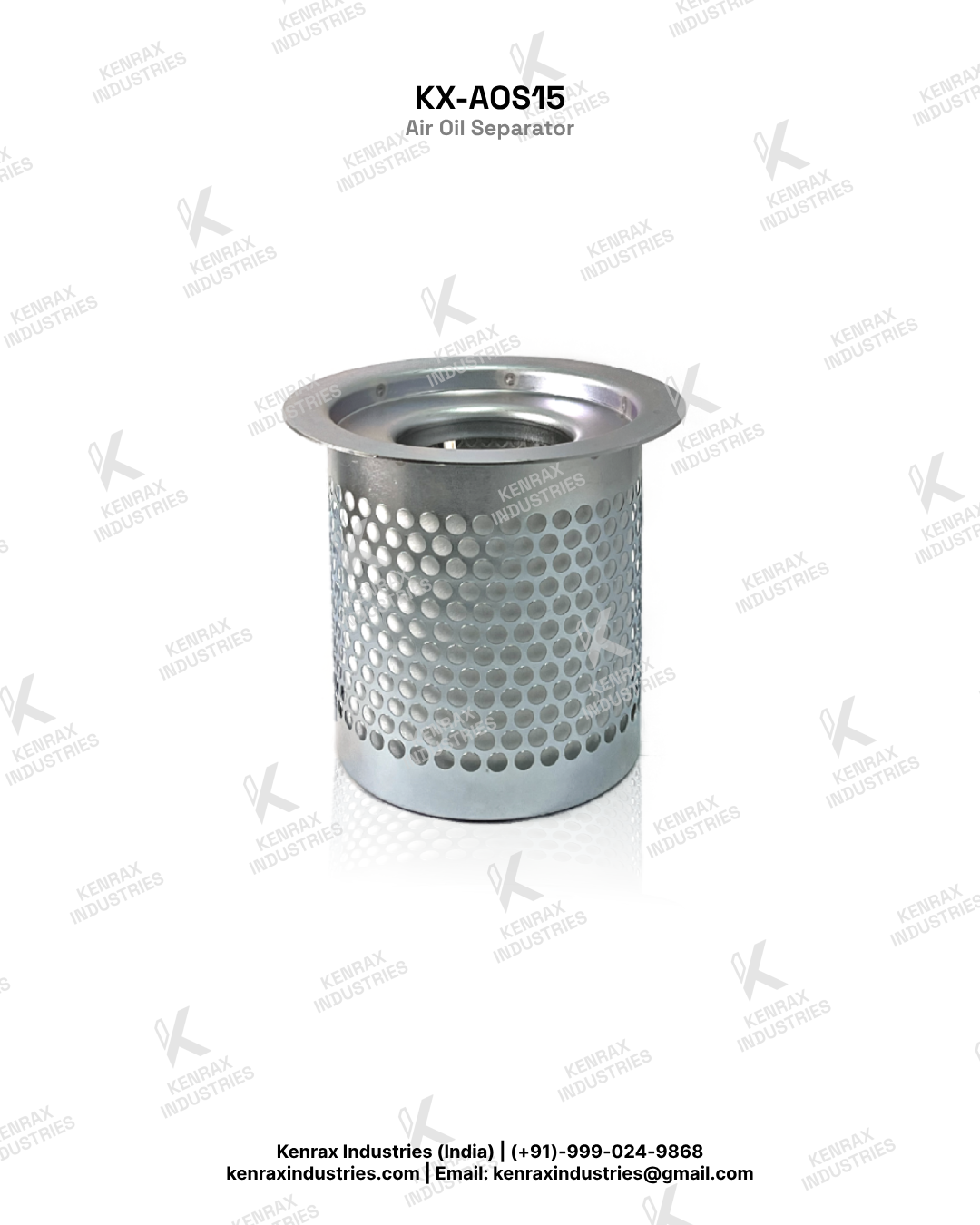
Oil carryover is the silent tax on compressed air. It does not announce itself with an alarm — it shows up weeks later as fouled dryers, clogged filters, gummed valves, discoloured products, and a compressed air bill that quietly grows. This guide explains what oil carryover is, what it costs, and how to eliminate it.
What oil carryover actually is
In an oil-injected screw compressor, the compressed air leaving the air end is an oil-laden mixture — a fine mist of oil droplets suspended in the air at full discharge pressure. The air-oil separator's job is to coalesce that mist back into droplets and recover it to the sump. 'Oil carryover' is the residual oil that escapes anyway, measured in parts per million (ppm) of the delivered airflow.
The relationship between separator age and carryover is not linear. It is a curve that stays low for most of the element's life and then climbs sharply near the end. That is why interval-based replacement catches problems that hour-based monitoring often misses.
What it does to each downstream component
Oil in the air stream does not stay 'in the air'. It deposits everywhere the air goes.
The cost side of carryover
The line items are mundane but they add up faster than any single bill:
In most plants, the single cheapest way to attack all of these simultaneously is to fix the source: keep the separator healthy, on interval, with the correct media.
How to measure carryover without an instrument
You do not need a lab to tell you carryover is climbing. These shop-floor signals correlate strongly with separator condition:
If you do have a lab or instrument, sample the air at the receiver and test for oil. A single measurement is a snapshot; two measurements six months apart give you the trend, which is worth far more.
Where the separator fits, and where it doesn't
The separator is the primary oil-removal stage, and keeping it healthy is the biggest lever. But it is not the only one. A complete oil-carryover defence at the system level is:
Prevention over cure
The cheapest point to act is always before the separator saturates. Spec the element to the OEM media, change it at interval, and keep the scavenge path clear. If you have done all of that and carryover still climbs, the conversation moves to the machine itself — oil level, temperature, and air end condition — rather than to the downstream cleanup bill.
The one-line summary
Oil carryover leaves through one component and damages everything downstream. Fix the source first: a healthy, correct-spec separator on an honest schedule. Kenrax supplies OEM-spec separators cross-referenced to your part number. You can order these directly from Kenrax on WhatsApp (or check price on the product pages).