
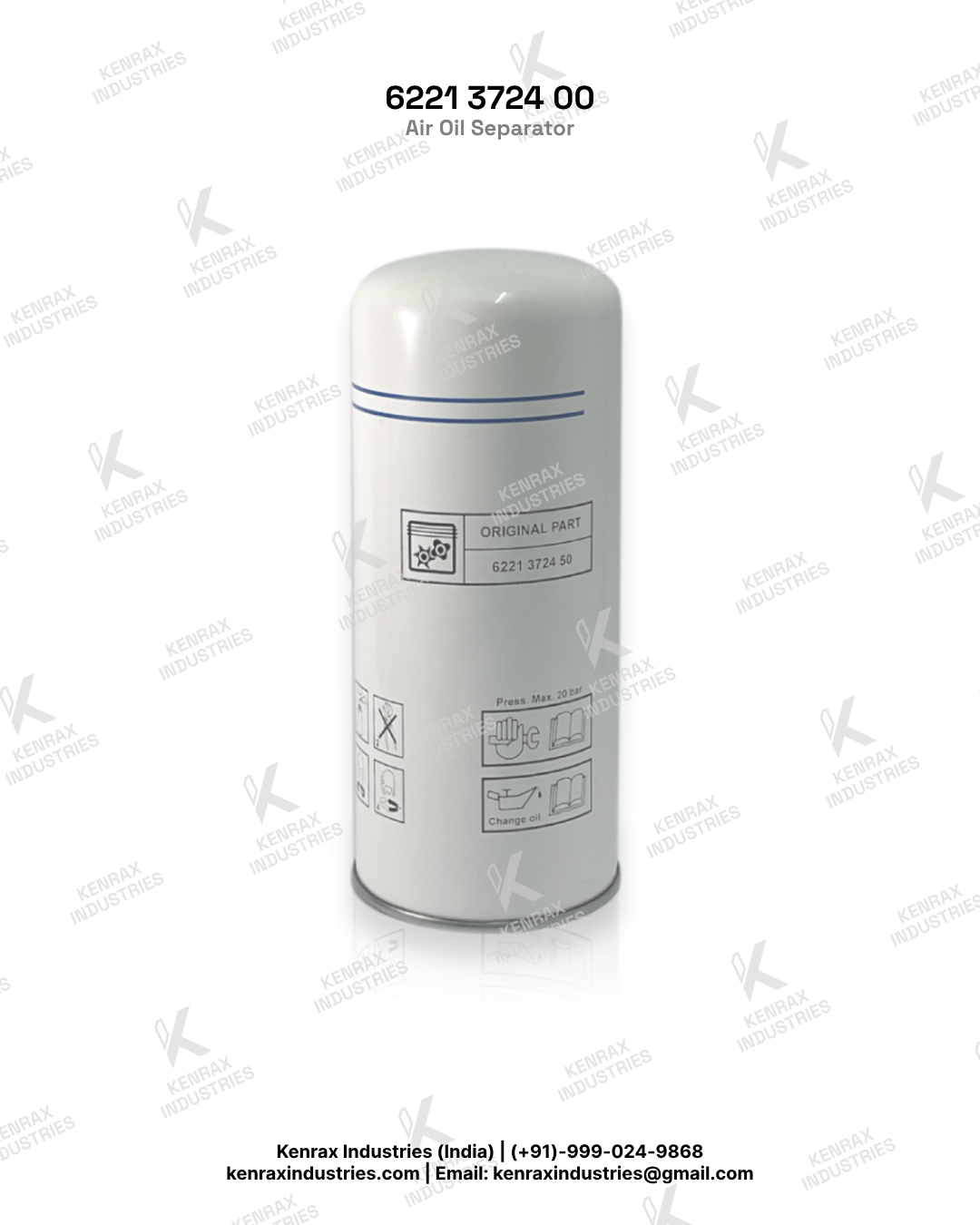
In a flooded screw compressor, the oil does far more than lubricate. It cools the air end, seals the running clearance between the rotors, and carries away wear particles and contaminants. The oil filter's job is to keep that oil clean for the entire interval between oil changes — a dirty oil filter quietly compromises all four functions.
What the oil filter protects
Every filter in a compressor has a reason to exist, and the oil filter's job is specific: to remove particulates from the oil so they do not circulate through the system.
Replacing an oil filter is cheap. Replacing an air end because the lubrication path was starved or abraded is not. The filter is the cheapest component in the whole oil circuit and the one with the largest downstream liability.
The standard replacement interval
Most OEMs specify the oil filter change at the same interval as the oil change, commonly every 1000, 2000, or 4000 operating hours depending on the compressor, its duty, and the environment. Two rules matter more than the number itself:
Signs the oil filter is or was failing
Many of the symptoms almost read like an oil problem, because a clogged filter and contaminated oil interact. Watch for these:
The bypass problem deserves its own spotlight
Almost every screw compressor oil filter has a bypass valve so that lubrication is never completely lost, even with a fully blocked filter. That safety valve is a good thing at cold start and during a genuine emergency. But it hides a very dangerous normal-running condition: when the element loads up and the bypass cracks open, the compressor keeps running sweetly while entirely unfiltered oil circulates. By the time anyone sees a warning, the damage is done.
This is precisely why the oil filter must be replaced on interval — not on visible symptoms. Unlike an air filter, you cannot open the housing and "look" at the element, and by the time the symptoms arrive, the filter has already failed at its job.
Cheap oil filters are a false economy
The oil filter specification includes more than the can's thread pattern. It covers the micron rating of the media, the dirt-holding capacity, the burst strength, and the anti-drainback behaviour on start-up. A cheap filter that looks identical can have less media, coarser filtration, or a weaker bypass door — and none of that shows up in a photo.
When you buy replacements, ask three questions: Does the media rating match the OEM spec? Does the filter have the same bypass setting? Is the construction (media, core, gaskets) rated for the compressor's oil flow and pressure? Kenrax manufactures its oil filters to the OEM specification for exactly these parameters. You can order these directly from Kenrax on WhatsApp (or check price on the product pages).
Practical checklist for your next service
The one-line summary
Change the oil filter on interval, always with the oil change, and never buy on thread size alone. The oil filter is a few thousand rupees of protection for a component set worth dozens of times more.