
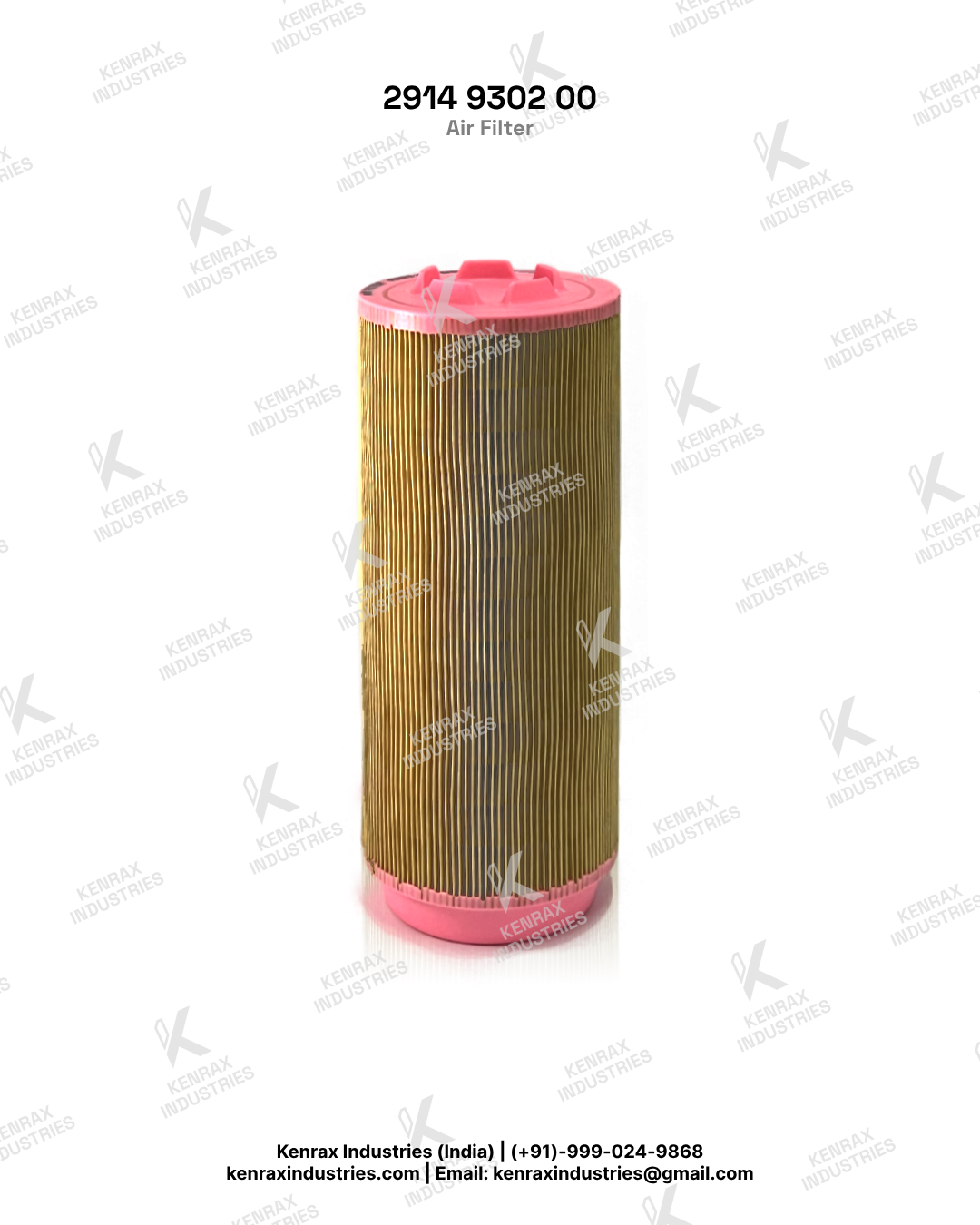
Air filters are cheap, and that is precisely why they are so commonly neglected. A plant manager will fight for a budget line on an air end rebuild but wave away a few thousand rupees on a filter. This guide puts hard numbers on what that wave-away actually costs — in energy, in downtime, and in the repair bills that quietly accumulate at the far end.
How a clogged filter breaks the compressor's economics
A screw compressor is a fixed-displacement machine: it pumps a near-constant volume of air at a given speed. If the intake is restricted, the machine does not 'give up and rest' — it keeps trying to pump the same volume against a higher effort. That effort shows up as higher power draw, higher temperatures, and eventually as mechanical stress.
The mechanism is simple: a clogged air filter raises the pressure drop across the intake. The compressor compensates by working against a higher pressure ratio, which means the rotors have to carry a heavier load and the air end has to reject more heat every revolution.
The energy arithmetic
Here is the back-of-envelope calculation that makes the cost concrete. For a compressor at nominal conditions, the power consumption scales roughly with the pressure ratio it has to produce:
The exact figure depends on your duty cycle and tariff, but the shape of the answer is the same everywhere: a severely loaded air filter is individually costing more than the replacement element that would have fixed it, every single year. The filter is literally free by comparison.
Many compressors also carry a service alarm for the air filter restriction precisely because the OEMs know this. An ignored service light is just a way of paying the energy bill twice.
The temperature and oil side-effects
None of these show up as a line item on the electricity bill, but together they drag the whole compressor toward earlier, bigger repairs.
The catastrophic end: filter bypass and dust ingestion
Most air filter housings have a bypass mechanism that opens if the element becomes so blocked that the differential pressure is extreme. Its purpose is to protect against a fully starved intake. But a bypass that opens during normal running is a disaster in slow motion: it lets unfiltered ambient air into the compressor.
The bypass is fundamentally a pressure switch, not a cleanliness guarantee. The only way to keep unfiltered air out of the machine is to change the element before it ever gets to bypass conditions.
The downtime component
Every minute a compressor is down is production lost, and production time is the most expensive unit in the plant. There are two very different flavours of downtime around this problem:
A filter occasionally reaching end-of-life between planned services is normal. A filter stretching from interval to interval while production 'orders it later' is how every unplanned outage happens.
The maintenance practice that fixes it
The one-line summary
A clogged filter costs more in energy per year than its own replacement price, drives temperature and oil degradation, and can end in an air end overhaul past bypass. Replace on interval and on condition — it is the highest-return maintenance decision in the compressor bay. Kenrax makes the OEM-spec air filters, oil filters, and separators for every major brand. You can order these directly from Kenrax on WhatsApp (or check price on the product pages).