
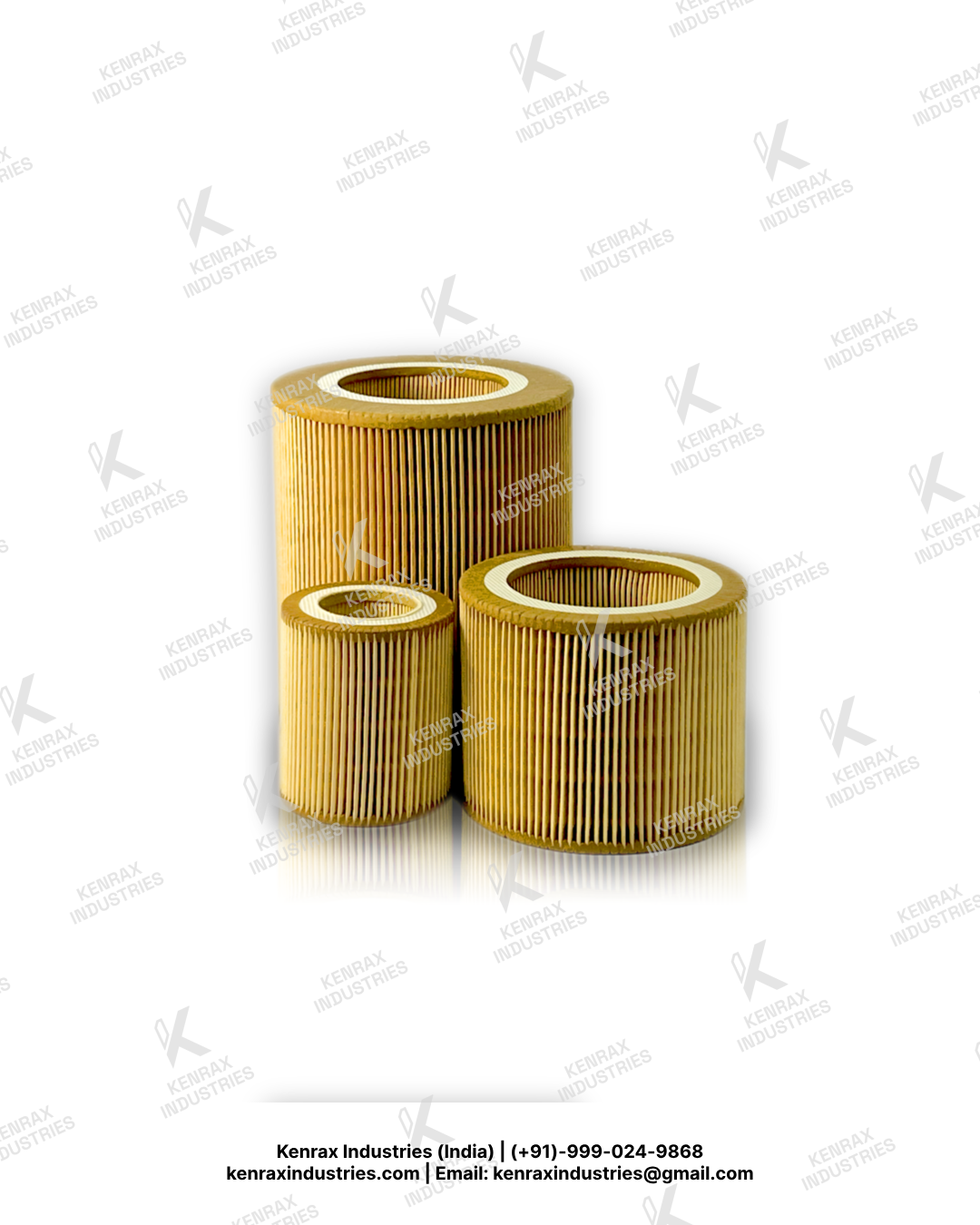
Every screw compressor has three consumable filters worth understanding — the air filter, the oil filter, and the air-oil separator. They work together to protect the machine and the air it delivers, and each fails differently. If you know what each one does, where it sits, and what its failure looks like, you can run a compressor with almost no surprises.
The three lines of defence
Think of the compressor as two circuits — an air circuit and an oil circuit — with the separator as the point where they meet.
Each sits at a different place in the machine, faces a different contaminant, and has a different failure signature. Yet they share one strategic truth: all three are cheaper than the damage they prevent.
The air filter — first line
Air comes in, gets filtered against dust, and enters the compression chamber.
The air filter is the only one you can inspect visually. If you can see loading, and especially if the compress-room dust level is visible, change it. It is the cheapest element and the most environment-driven.
The oil filter — the circulation guard
Oil circulates through the air end continuously, carrying heat and sealing the rotors. The oil filter cleans that recirculating oil.
You cannot 'inspect' the oil filter. Change it when the oil is changed, every time, without exception — the two go together because a contaminant-loaded element has no value to a fresh fill.
The air-oil separator — the last gate
Compressed air leaves the air end at high pressure carrying an oil mist. The separator coalesces those droplets and returns the oil to the sump, releasing nearly oil-free air.
The separator is the component whose failure has the widest ripple: it costs oil, it fouls everything downstream, and it quietly degrades air quality you may be certified against.
How the three interact
The filters are not independent. A failing air filter makes the machine run hotter, which degrades the oil, which loads the oil filter faster and pushes sludge into the separator. A separator that returns oil poorly leaves the sump low, which makes the machine run hotter still. It is one system wearing from three directions.
That interaction is why the professional habit is to treat the three as a kit: change all three on the compressor's service schedule and the whole machine stays in its design band. Mixing intervals — 'just the air filter this time' — is how imbalances creep in.
Reading your machine's 'vitals'
With a little history, three indicators tell you the health of all three filters at a glance:
Log these at every service and you will see drift days before any alarm. You will also know exactly which element to blame when a symptom appears — which is the practical dividend of understanding the system.
Buying all three from one place has real advantages
Lineage matters. If you buy the three service elements from one manufacturer that builds to the OEM spec, the cross-referencing is done once, the parts arrive together, and the compatibility is documented rather than assumed. Kenrax manufactures all three — air filters, oil filters, and separators — for the major screw compressor brands, each matched to the OEM part number and media spec. You can order these directly from Kenrax on WhatsApp (or check price on the product pages).
The one-line summary
Air filter guards the intake, oil filter guards the circulation, separator guards the exit. Treat them as a system serviced as a kit, log the three vital indicators, and the compressor will tell you exactly what it needs next.